
Cast bronze bushings – standard sizes and to drawing
Sleeve bushings, flanged bushings and thrust washers CNC-turned and bored from continuous-cast and centrifugally cast bronze bar and tube. C93200 / SAE 660 (RG7) as standard; SAE 64, CuSn12, CuSn10P, LG2 / C83600, aluminium bronze C95400 / C95500 and C86300 to order. ISO 4379 metric series Ø6 – 200 mm from the size chart, any other size to drawing from Ø3 to Ø1000 mm. Greased or oil-lubricated; for pins, pivots and slow shafts under heavy load.
- Ø6 – 200mm ISO 4379 standard series
- Ø3 – 1000mm to drawing
- 12cast bearing alloys in the programme
- 3 – 5 dayssamples, free of charge
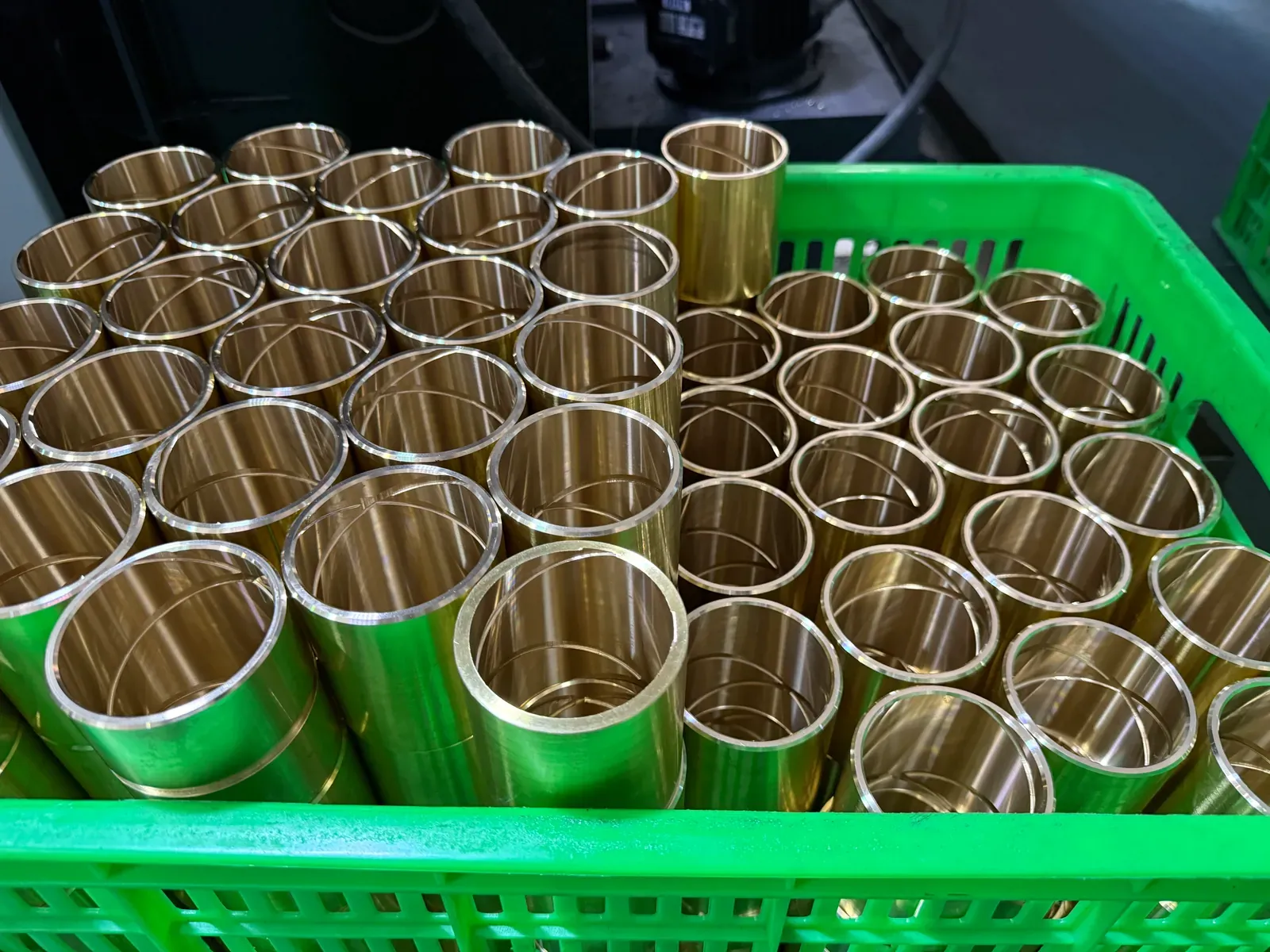
What a cast bronze bushing is
A cast bronze bushing is a plain sleeve bearing machined from a solid cast copper alloy – most often C93200 / SAE 660 leaded tin bronze – that carries a rotating or oscillating steel shaft on a grease or oil film. It has no steel backing, no plastic liner and no oil stored in pores: the whole wall is bearing metal, so it can be bored, grooved, re-machined and run at loads and temperatures composite bushings do not reach.
- Material: continuous-cast (ASTM B505) or centrifugally cast (ASTM B271) bronze bar and tube, uniform dense structure, machined all over
- Load: 25 N/mm² moving, 45 N/mm² stationary, up to 0.5 m/s greased – heavier than sintered or plastic bushings, shock and edge loading tolerated
- Lubrication: external – grease through an oil hole and grooves, or oil bath; the bronze is not self-lubricating
- Forms: sleeve (ISO 4379 Type C), flanged (Type F), thrust washers, and stepped, grooved or large-diameter parts to drawing
- Temperature −40 to +250 °C, resistant to water, weak acids and seawater depending on the alloy
Sleeve, flanged and thrust washers – three standard forms, plus parts to drawing
The standard series follow ISO 4379 (the successor of DIN 1850): three wall thicknesses per bore for sleeves, two flange series, and the lengths the standard lists. Everything else – oil grooves, holes, steps, inch sizes, Ø200 to Ø1000 mm – is machined to your drawing or to the three dimensions of a worn part.
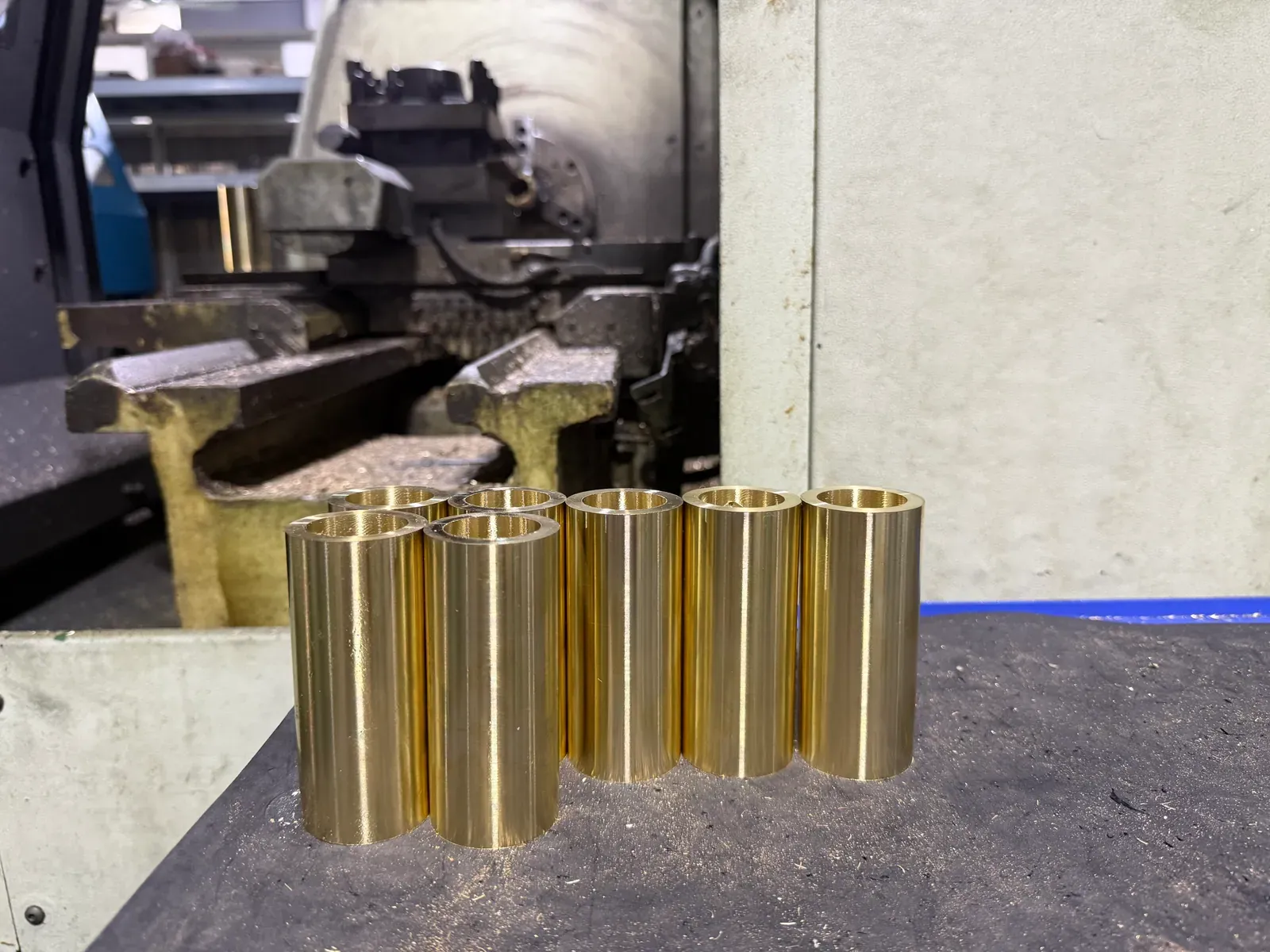
Sleeve bushings
Plain cylindrical bushes d × D × L, Ø6 – 200 mm bore, three outside diameters per bore. Pressed into an H7 housing; the bore closes to about H8. Pins, pivots, gearbox and pump shafts.
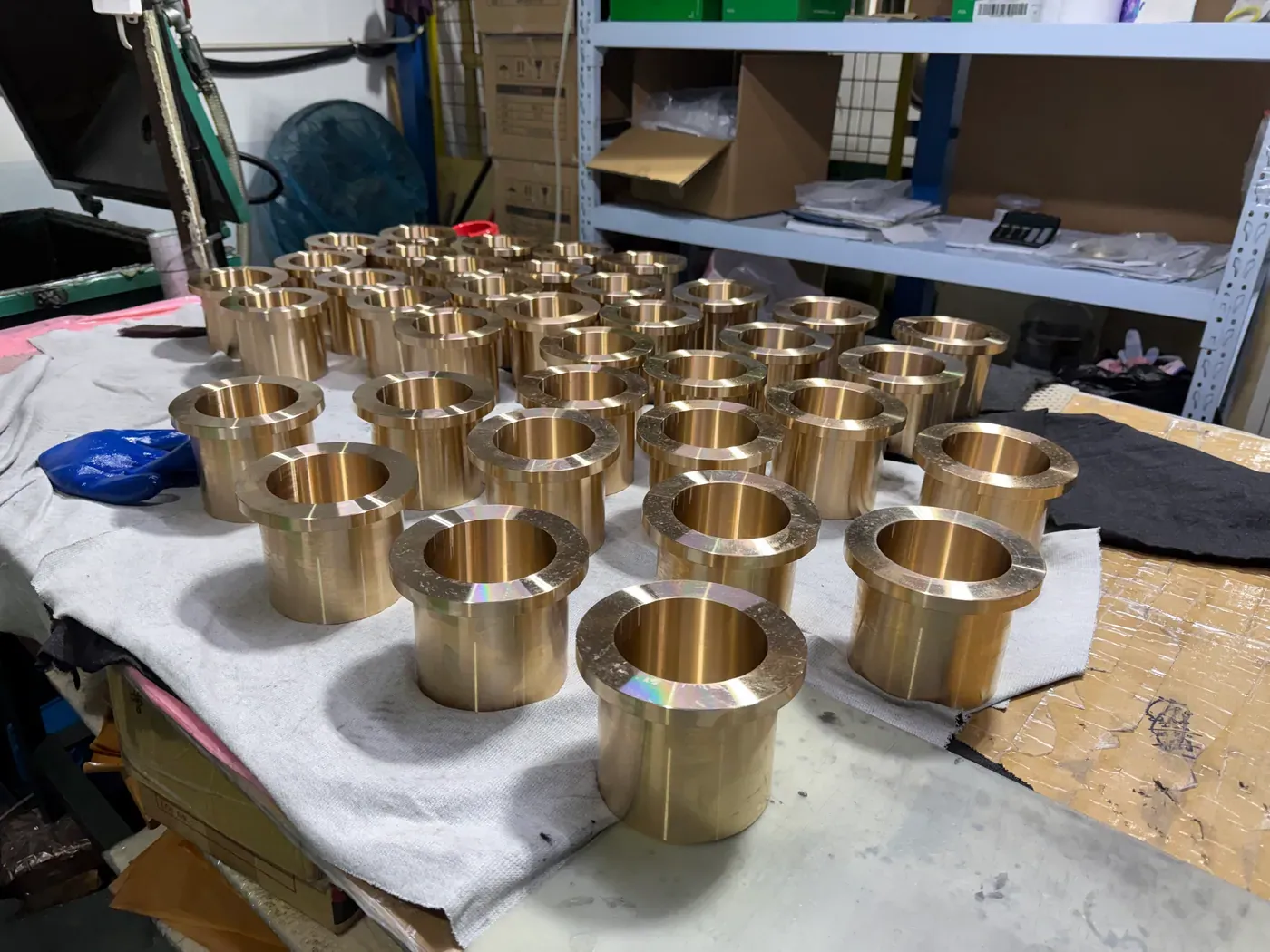
Flanged bushings
Sleeve with a locating flange that takes light axial thrust and stops the bush walking. ISO 4379 Series 1 (thin flange) and Series 2 (heavy flange), Ø6 – 200 mm.
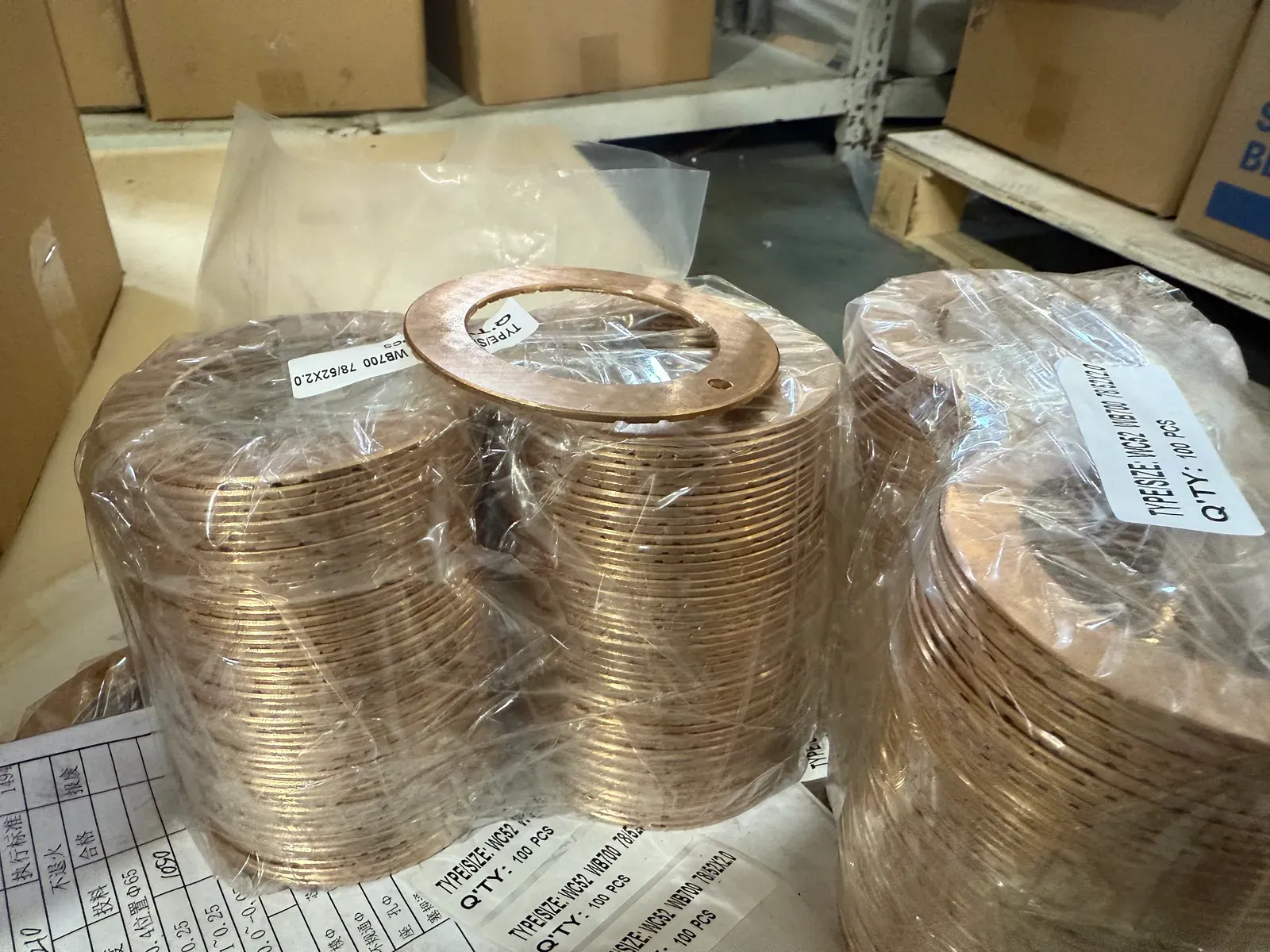
Thrust washers
Flat bronze rings that carry axial load between a shaft collar and a housing, Ø12 – 200 mm shaft, plain or with radial grease grooves.
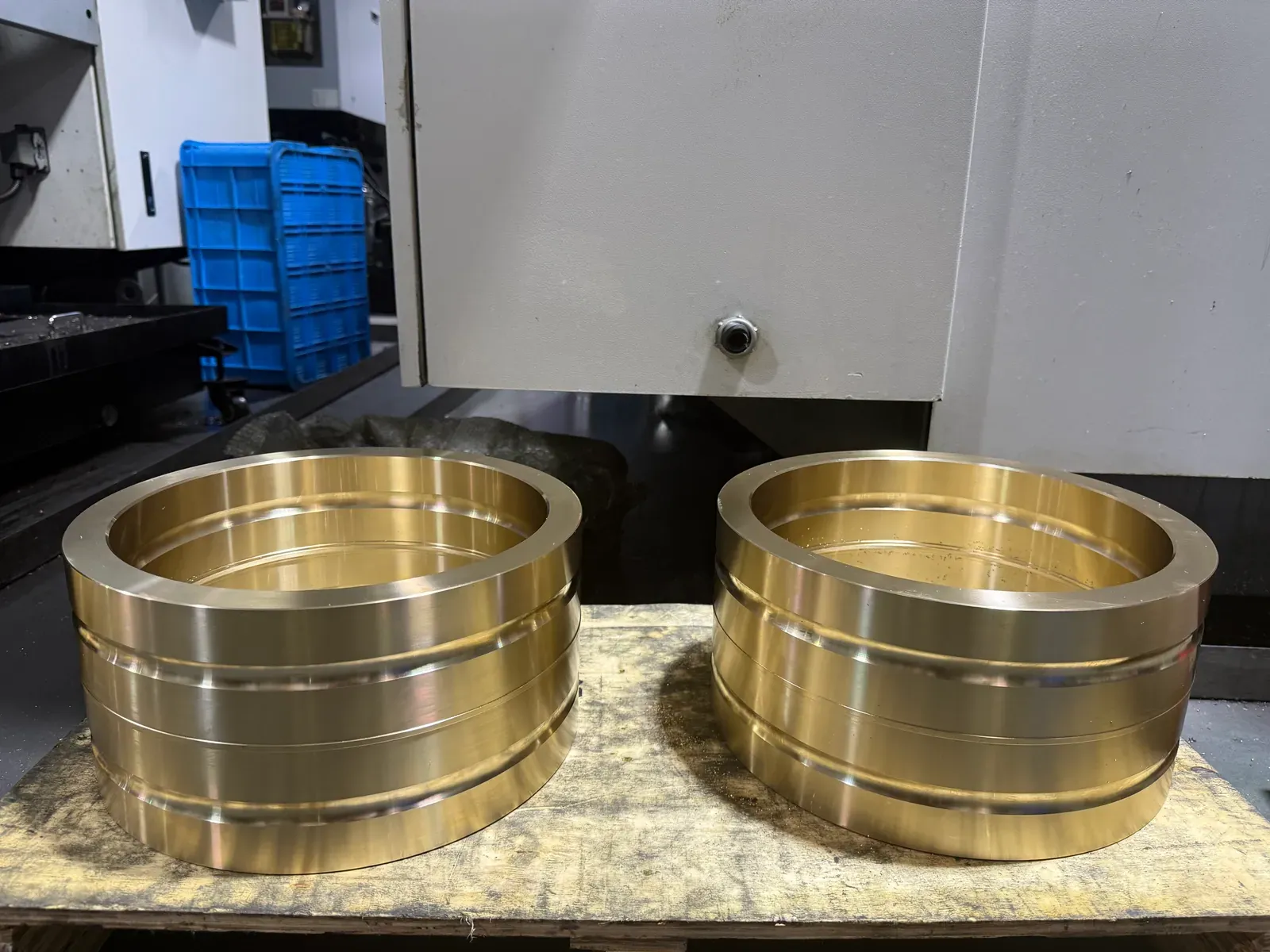
Custom bushings to drawing
Stepped bushes, oil grooves and holes, half bearings, large bushes to Ø1000 mm, inch sizes, any of the twelve alloys. Send a drawing or the dimensions of the old part.
Which bearing bronze for which duty
Twelve cast bearing alloys are in the programme. The right one depends on load, shaft hardness, lubrication and the medium – not on the name your drawing uses. Every grade page lists the SAE, EN, DIN, BS, JIS and GB designations, and the cross-reference explains which "equivalents" are really the same alloy.
| Condition | Grade | Bearing character |
|---|---|---|
| General duty, unhardened shaft, grease | C93200 / SAE 660 · RG7 · CuSn7Zn4Pb7 | The default bearing bronze: 7 % lead embeds dirt and covers short lubrication gaps, 65–75 HB runs on a plain steel shaft. |
| Poor lubrication, shock, mine water | C93700 / SAE 64 · CuSn10Pb10 | 10 % lead for interrupted lubrication and soft shafts; C93800 / SAE 67 (15 % Pb) for the worst lubrication. |
| Lead-free, higher wear resistance | CuSn12 · CuSn10P (B101 / PB1) · CuSn10 | Tin bronzes at 90 HB and above for hard shafts, higher loads and seawater; the lead-free replacement for 660. |
| Pumps, valves, water, light load | LG2 / C83600 · CuSn5Zn5Pb5 | Leaded gunmetal: pressure-tight, corrosion resistant, easy to machine; the Commonwealth and Japanese (CAC406) default for water service. |
| Heavy load, seawater, hot | Aluminium bronze C95400 · C95500 · CuAl10Fe3Mn2 | 586–655 N/mm² minimum tensile, 150–195 HB: shock and cavitation resistant, needs a hardened shaft and continuous lubrication. |
| Extreme load at very low speed | C86300 / SAE 430B · CuZn25Al5Mn4Fe3 | 758 N/mm² minimum tensile, 225 HB – the strongest cast bearing alloy; hardened shaft and clean lubricant essential. |
Operating limits – greased cast bronze bushings
One set of design limits applies to the whole range under boundary lubrication (grease or oil without a full hydrodynamic film) with the fits below. They are the values we quote against; a grade, speed or duty outside them is checked on request.
| Parameter | Typical | Unit |
|---|---|---|
| Specific load p, moving | 25 | N/mm² |
| Specific load p, stationary | 45 | N/mm² |
| Sliding speed v | 0.5 | m/s |
| Coefficient of friction | 0.08 – 0.15 | µ |
| Working temperature | −40 … +250 | °C |
| Housing | H7 | ISO 286 |
| Shaft | e7–e8 | ISO 286 |
| Condition | grease or oil, boundary lubrication, steel shaft | |
Confirmed by Slidura engineering, 2026. Values depend on alloy, shaft finish and relubrication interval; the design guide shows how to check specific load and PV for your position.
When a cast bronze bushing is the right choice – and when it is not
Cast solid bronze wins where the load is high and the movement slow or intermittent, and where the bushing must be machined, grooved or re-bored on site. Other constructions win where lubrication is impossible or speed is high.
Oscillating pins under heavy load
Boom, bucket and steering pins on construction machines: high specific load, small angles, shock. The thick bronze wall carries 25 N/mm² and embeds grit that would score a thin liner.
Edge loading and misalignment
Trailer axles, harvester headers, mill roll necks. A soft 65–75 HB bronze conforms to the shaft instead of cracking a liner or brinelling a rolling bearing.
Large or non-standard sizes
Above Ø200 mm most bushing constructions stop; cast bronze goes to Ø1000 mm, and a stepped or half bearing is just another machining programme.
Lubrication is available
Where a grease nipple, oil bath or drip feed exists, the plain bronze bore with a groove pattern is the cheapest durable bearing.
Heat, water, seawater
Bronze keeps its strength to 250 °C; aluminium bronze and gunmetal resist seawater and process water where steel-backed bushings corrode.
Not the right choice
No relubrication possible – use graphite-plugged or metal-polymer bushings. Continuous rotation above 0.5 m/s with light load – use wrapped bronze, bimetal or rolling bearings. Both are compared on the types page.
Standard sizes and order codes
The size chart lists the ISO 4379 metric series with a bore filter: type the bore, read the outside diameters and lengths, click a length to put the order code in a quote request. Codes read grade – bore – outside Ø – length: 660-253020 is a C93200 sleeve Ø25 × Ø30 × 20 mm; F marks a flanged bush, W a thrust washer.
- Sleeve bushings Type C: 46 bores Ø6 – 200 mm, three walls each, lengths 6 – 250 mm
- Flanged bushings Type F: same bores, Series 1 thin flange and Series 2 heavy flange
- Thrust washers: Ø12 – 200 mm shaft, 2 – 12 mm thick
- Tolerances ISO 4379: bore E6 before fitting, outside s6 / r6, housing H7, shaft e7 / g7
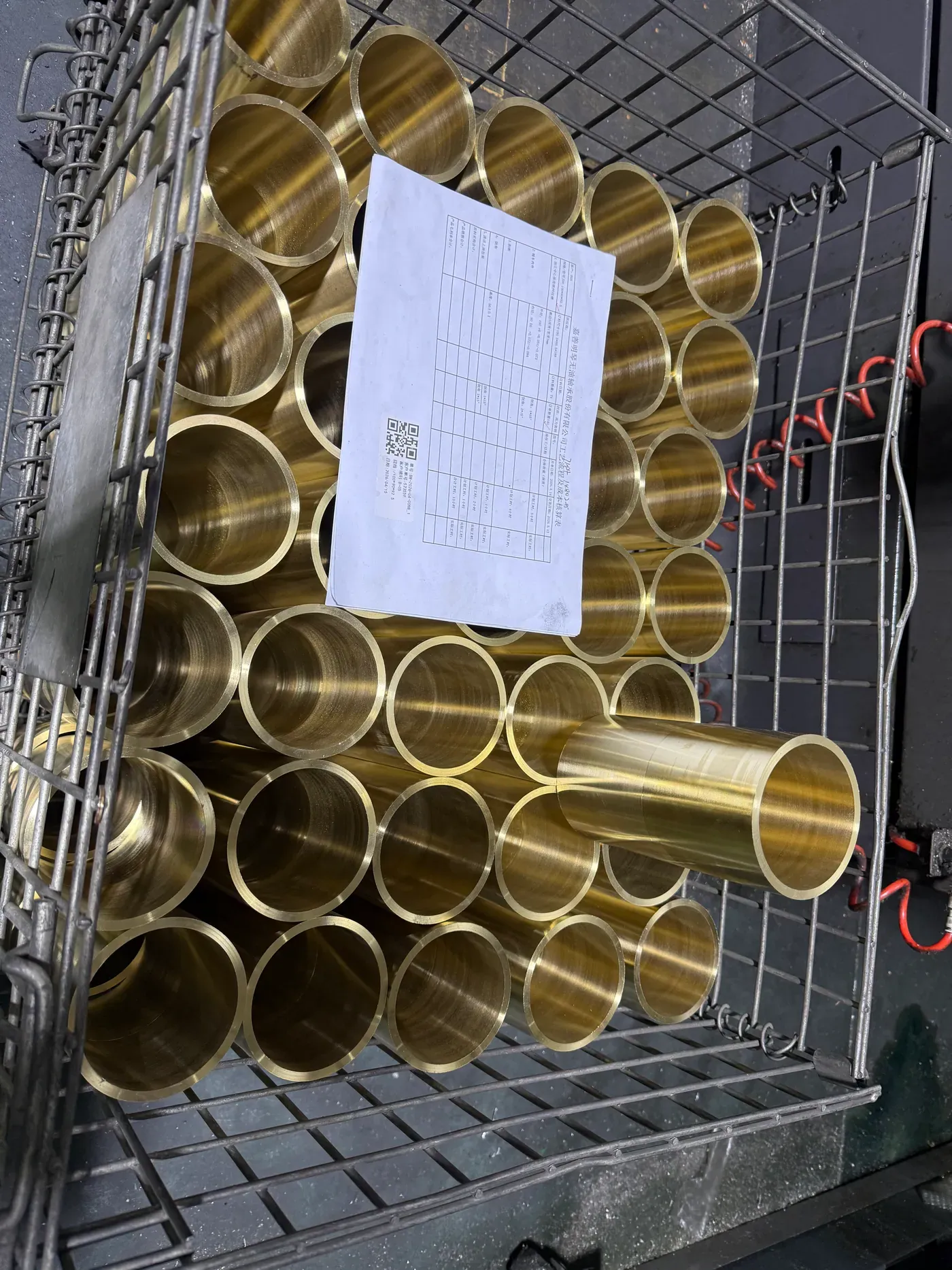
Applications
Where the parts go: the four industries that account for most cast bronze bushing enquiries, with the positions, alloys and sizes each one uses.
Construction and mining machinery
Boom, stick and bucket pins, steering knuckles, crusher toggles, cylinder eyes – C93200, C86300 for the heaviest pins.
Agricultural machinery
Tractor front axles and linkages, harvester and baler pivots, plough and cultivator arms, trailer axles – C93200 and SAE 64.
Pumps, valves and hydraulics
Pump shaft bushes and wear rings, valve stem bushes, cylinder gland and rod-eye bushes – LG2, tin bronze, aluminium bronze.
Steel mills, sugar mills, heavy industry
Roll-neck and table-roller bushes, mill bearings, crane sheave bushes, press guides – large diameters in C93200, aluminium bronze, C86300.
How to order
No minimum order quantity. Standard sizes and parts to drawing follow the same three steps.
Send a drawing or three dimensions
Bore, outside diameter and length of the old part are enough, plus quantity, alloy (or the designation on the drawing) and one line on the duty: load, speed, temperature, lubrication. Attach a photo if there is no drawing.
Quotation within 12 hours
Price per piece, alloy confirmation with the standard it is cast to, tolerances we will hold, lead time and shipping terms (EXW, FOB, CIF or DDP door-to-door in more than 30 countries).
Samples in 3 – 5 days, then the batch
Samples of standard and custom parts are free. Batches ship with a raw-material certificate and, on request, a CMM dimensional report. Typical machining throughput is about 10,000 pieces a day across 25 CNC lathes and boring machines.
Facts, not claims
- 2007Slidura founded, Jiaxing, China
- ISO 9001 · IATF 16949certified quality system, PPAP level 3 on request
- 25CNC lathes and boring machines
- No MOQone piece to series, free samples
- CMM reportand material certificate on request
- RoHS · REACHcompliance documented; lead-free grades available
Shipping to North America and Europe
Cast bronze bushings are classified under HS 8483.30 (plain shaft bearings, bushings): US HTS 8483.30.80, EU TARIC 8483 30 80, India HSN 84833000. We quote EXW, FOB Shanghai / Ningbo, CIF or DDP; import duty and any additional country tariffs are the buyer's cost at the rate valid on the day of entry. For the United States the additional tariffs on Chinese-origin parts are substantial and change – tell us the destination and we calculate the landed cost per piece before you order, so the comparison with a domestic supplier is honest.
Canada, the EU (8 % third-country duty on 8483 30 80), the UK, Turkey, Brazil and Latin America receive regular consignments by sea (typically 30 – 45 days port to port depending on the destination) or by air for samples and urgent batches. Consolidated shipments with other Slidura products are possible.
Frequently asked questions
Is bronze good for bushings?
Yes, for slow and heavily loaded shafts. Cast bearing bronzes combine a soft, conformable matrix (tin bronze) with lead or hard intermetallics that give low friction against steel, embed dirt, resist corrosion and keep their strength to 250 °C. The limits are speed – above about 0.5 m/s the grease film needs help – and the need for external lubrication.
Is SAE 660 the same as C93200?
Yes. SAE 660 is the old SAE J461 / J462 name, C93200 the UNS number of the same 83-7-7-3 leaded tin bronze (Cu 81–85, Sn 6.3–7.5, Pb 6–8, Zn 1–4 %). CDA 932 and "bearing bronze" mean the same alloy; RG7 / CuSn7Zn4Pb7 (CC493K) is the European casting of the same composition.
Do cast bronze bushings need lubrication?
Yes. Solid cast bronze is not self-lubricating: it needs grease through an oil hole and grooves, an oil bath or a drip feed. Leaded grades tolerate short interruptions because the lead smears over the surface, but they wear fast if the grease is missing for long. For positions that can never be relubricated we point you to graphite-plugged or metal-polymer bushings.
What sizes can you make?
Standard ISO 4379 sleeve and flanged bushings from Ø6 to Ø200 mm bore and thrust washers to Ø200 mm shaft are in the size chart. To drawing we machine from Ø3 to Ø1000 mm diameter, in any of the twelve alloys, including inch sizes, stepped and half bearings.
What is the HS code for bronze bushings?
8483.30 – bearing housings not incorporating ball or roller bearings; plain shaft bearings. US HTS 8483.30.80, EU TARIC 8483 30 80, India HSN 84833000, Brazil NCM 8483.30. The classification does not depend on the alloy.
Send the drawing or the three dimensions
Quotation within 12 hours, free samples in 3 – 5 days, no minimum quantity. Tell us alloy (or the old designation), quantity and the duty, and where the parts ship to.